Back when my hair started falling out, I remember several people telling me: “Just think of how much time you’ll save in the shower!” I know it was said with the best of intentions, but maybe don’t go saying that the next time you encounter a friend with cancer.
Still, showering was much simpler. My showers didn’t get shorter, they just got better. Not only did I get to skip the shaving, but I got to skip the stress of just needing to shave. Trying to remember if I’d shaved my armpits first, or if I needed to do them before I got out of the shower. With no hair, I could wash my head or not. I usually conditioned my bald head, afraid that the skin would dry out. (A bald head is one thing, a scaly bald head is something else entirely.) Instead of spending all that time washing and shaving, I just stood and enjoyed the hot water on my body. A quick slather with some jojoba oil when I hopped out, and I was ready for makeup.
While I was on taxol, I ended up with a fair amount of bone pain for a few days each cycle. It wasn’t so much a sharp pain, but it became very hard for my legs to be comfortable. Enter the wonder shower– sometimes two or even three times a day I’d hop in and let the hot water soothe my achy body. With no hair, I could hop straight into bed after my shower and didn’t even get cold from my wet head. Showers were such a relaxing, enjoyable time to me, I really do miss having a shower without having an agenda.
This post is part of a series of what I’ll miss from my time as a cancer patient. I know cancer is a serious thing, not everyone tolerates treatment well, and not everyone recovers. I don’t mean to offend by making light of a serious subject. These posts are just a glimpse of my efforts to make the best of my situation—to find the silver linings wherever I can.
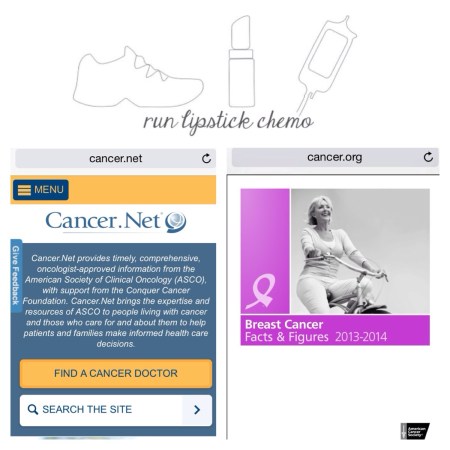
I know that a lot of people probably come to this site looking for answers to questions after a breast cancer diagnosis. I will be the first person to tell you to stay off the internet if you have questions– a doctor is always your best bet. But I am also the first to admit that a lot of questions– the ones that seem the scariest of the most pressing– come just after a doctor’s office has closed for the day. Or the weekend. If you’re heading out to the internet, please, please, please check the source. All internet information is not created equal. I think you could probably find nearly everything you need in just two places.
Cancer.net is a great site curated by ASCO (the American Society of Clinical Oncologists) for patients. Since it is designed for patients, the information is easy to understand– conversational, not overly technical. And because it is vetted by oncologists, it has complete, reliable information. Besides offering basic cancer information, they feature a lot of articles and videos talking about everything from choosing a doctor, managing side effects of treatment, dealing with the emotional and financial ramifications of cancer treatment, and even thriving in survivorship once you’re declared cancer free.
My other favorite American Cancer Society’s page, I’ve headed there for years– that’s always where I got my breast cancer incidence stats back in grad school. This past weekend, I was working on a project and took the time to look through their annual publication, Breast Cancer Facts and Figures. This is a gold mine! It has all kinds of stats on incidence broken down by region, age, ethnicity… But they also have great information on diagnostic procedures, treatment plans, and pathology results. They cover nearly every breast cancer question I’ve heard, but the kicker is that they cite their references! This is a huge deal to science nerds like myself– not that I’m going to read every original article they cite, but when it’s important, I like being able to find the original, peer reviewed document to support what I’m going to say.
I’ve started a new Resources page here on Run Lipstick Chemo. Links to these two pages will be there, and I’m going to include some local resources as well. I’ll update it as I find new things to share, and I’ll do my very best to keep the standards high on that page so that you can trust the information you find there. It’s a work in progress, but I feel like these two resources stand on their own, so wanted to give you the heads up as soon as possible.
I was definitely one of those type A kind of students. I worked hard and got really good grades. I remember that one time in high school when I got a B. On a quarterly grade report. Well, that was a wake up call, friends. (Oh, the wake up call that awaited me in honors organic chemistry in college…)
As a stay at home mom, there are no more A’s. No standardized tests where you can score in the 90th percentile. There are no annual evaluations where your boss tells you how valuable you are to the company and gives you a raise. If you’re lucky, you get an occasional thank you. Would you believe Emma Clare thanked me last night for putting her laundry in the dryer for her?!? And yes, she does laundry, maybe I’m better at this mom thing than I think! But for the most part, there are no more formal accolades.
But yesterday, I unwittingly walked in to a situation where I would be tested. And I didn’t even study! I went to Body Dynamics, Inc.– a fitness center offering physical therapy, personal training, and group fitness classes. I’ve been wanting to spend a little time with a personal trainer to work on my upper body strength. After my mastectomy, my back and pectoral muscles are all rearranged, and with the tingly nerves on my chest, my surgeon suggested I might avoid too much pec work to keep from agitating those already angry nerves. I’m fortunate and have great range of motion after my surgery, but the way the muscles are rearranged makes it important that I strengthen my back muscles to help keep my shoulders back. If I’m also trying to do that without taxing my pecs too much, I’m gonna need some pointers. To do any training at Body Dynamics, you have to do an evaluation first, so I showed up yesterday in my workout gear and sneakers, ready to go. Basically, the physical therapist gave me all kinds of weird tasks to do “until fatigue” and she stared at me and timed me. (That’s after the weighing and waist measuring.) Awesome.
First up, the step test. She stacked three step aerobics-style steps up and I had to step up and down for three minutes. At tempo– 88 beats per minute. That’s less than one Mississippi between each step. Then stand on one leg as long as you can, then switch legs and do it again. Then stand on one leg and do calf raises without bending your knee, then switch. Do squats as long as you can. For all of the leg strength and the bicep curls, I got into the 100th percentile! That’s an A+, folks! Several of the tests she stopped me because I’d reached the top percentile before I quit or she called time. Makes an overacheiver feel good. Of course, it’s not to be overlooked that I did have some rather important muscles cut up, rearranged, and stretched out in the last eighteen months. So my core, which draws a lot of support from the back, is in need of some serious strengthening. We skipped the push up test and I didn’t last very long at the side plank, but it didn’t kill me, either. I’ll head back next week to work with a trainer on my core and get some specific tips to work my back and arms. Of course, I’m already wondering about emailing the PT I worked with to find out how long I have to do the core tests to be in the 90th percentile. We can count this visit as the pre-test, but I’d like another chance to ace the real thing!
It seems that one of the most frequent questions I’m asked is about how to gift a friend with cancer. I have such generous friends who know me so well who gifted me with such thoughtful tokens. The last time someone asked me this question, I started to list for her all the things people had given me and things that I’ve given others since. But it occurred to me that the perfect gift for me might not be the perfect gift for someone else. There aren’t a whole lot of things that someone going through cancer needs. Yes, once your hair falls out, you’ll need a few good hats, so that’s a nice place to start. But really, gifting a friend is about making her happy. So what makes her happy? If chemo makes her feel badly, then probably don’t buy food or smelly candles. And if she’s trying to work and is exhausted, then don’t insist on taking her out for dinner. For me, the best gift was always time. An easy run, thrift shopping trip, or coffee or lunch date was exactly what I wanted. But if you don’t live close to your friend or your schedules just won’t match up, here are a few ideas. Just remember, keep in mind her personality– give her something that will make her smile!
Starbucks card. If you can’t go with her to coffee, you can help her take someone else!
Jewelry. Of course, who wouldn’t love a little blue box? Alas, I had to earn that one. But several friends know that a pretty bracelet or pair of earrings always brightens my day. Even almost two years later, I still smile, remembering the thoughtful giver when I wear a special gift.
Something completely frivolous. I would never buy an Us Weekly magazine. Not that I am above being sucked in by salacious celebrity gossip. But I would feel guilty, I should spend my money on something more redeeming. But when it comes from a fun friend? What an indulgent way to pass the time!
After I had my mastectomy, the neighborhood ladies took me to get a pedicure. Such a fun outing! A gift card for a pedi would be a great gift for a friend after surgery, but a mani/pedi is off limits while she’s on chemo. Maybe a gift card for a massage instead?
Of course, especially if you live nearby, things like childcare and dinner are always appreciated. Pitching in with some friends for an occasional visit from a house cleaning service would be amazing. But really, what I wanted from my friends more than anything was their friendship. Pay attention to her– what makes her happy? What is making her smile right now? Lip gloss, twizzlers, a sassy tee, or her very own cancer card. (Man, I wish I’d seen those back when I was in treatment. I would have whipped that bad boy out. I wonder if it would have gotten me out of a parking ticket if I threw it in my dash instead of the parking meter receipt…)
I had a friend who was so sick during her chemo, the only thing that she wanted to eat was an Egg McMuffin, so I would drop one off every once in a while. When I was diagnosed, she had moved away, but sent me the sweetest card with a McDonald’s gift card. You should have seen the smile on my face. Clay thought it was the strangest gift ever, I don’t even really like McDonald’s. But I understood the gift, and it made me so happy. Another great gift? The back scratcher a friend picked up after I complained that percocet made me itchy and I couldn’t scratch my own back after my mastectomy. Neither of those gifts came in a fancy blue box, but they both showed me that my friends were really listening to me and thinking of me. As much as I love me a little blue box, I’d prefer a thoughtful little gift any day.
This was the bulk of our crew when we headed camping two years ago. I call it the ill-fated camping trip. I wasn’t the most eager camper to begin with. Then we lost Turner after dark and our sweet babysitter had a run in with the law when she tripped our house alarm (we shouldn’t have set it since we’d planned for her to come take care of our dog!). That sort of puts a damper on things… I was so thankful for the trip, though, as it gave our family the chance to get to know some of our neighbors so much better. And we really did have a good time. Who needs to sleep, anyway? Today we were talking whether I was planning to chaperone an overnight fifth grade camping field trip. (Um, no.) A friend who was on that ill-fated camping trip said I had the best excuse for not going camping ever. I didn’t have cancer before I went camping. I came home, then I had cancer. Argue with that one.
Today was back to school day at our house. Thank goodness. Those kids needed to go back to school. For all of the learning, of course. As it turns out, apparently I had a little learning to do myself. (And yes, that’s the dog’s head. She’s missing her playmates. And driving me crazy.)
When we went around the circle of parents left at the bus stop discussing the glorious plans we all had for the day, they were about what you’d expect. Jiffy Lube, Target, spider removal from a chandelier… My goal for the day: make some lists. You know I love me a good, long list with checkboxes. Got my list made. (Check.) Then I proceeded to start checking off the boxes. Of course, I started with the easy ones. Then I got down to a tougher one: the great mammogram debate. (Insert dramatic dun-dun-DUNNNNN music here.) After hearing a lot about overdiagnosis and the inability of mammography to reduce the number of advanced cancers, I’d heard something about a new study that contradicted it, and decided I needed to clear it up.
Now hold on tight folks, it’s about to get a little science-y up in here. But I think I can get you through it. If a screening protocol is working, then one would expect to see more diagnosis of early stage disease and fewer cases of advanced disease. If you’re “catching it early,” then it will be diagnosed before it advances. Make sense? A study published in the the New England Journal of Medicine (very reputable) by Bleyer and Welch in 2012 looked at deaths from breast cancer in a roughly thirty year period since the introduction of mammography, and found that while there was a significant increase in overall cases of breast cancer, there was only a marginal (read: tiny) decrease in advanced disease. This led the authors to conclude that mammography was leading to a significant overdiagnosis of breast cancer (leading to the treatment of disease that would otherwise not kill the patient) without substantially decreasing the incidence of advanced disease. Their takeaway: mammograms don’t catch advanced disease early and catch a lot of otherwise insignificant disease. (Their subtext: mammograms are more trouble than they’re worth.)
I have to be honest. I didn’t like this. This put mammography into the “non-evidence based” decisions in my mind, right up there with contralateral prohylactic mastectomy. The evidence didn’t point to its benefit, but I just couldn’t imagine that mammography didn’t have a place in helping breast cancer patients. Until today.
In today’s issue of Cancer (also reputable, published by the American Cancer Society), Helvie et al. (that’s scientist speak for “and others”– Helvie’s group) published another look at that same data set. But they made one little tweak to their analysis that made a big difference. They adjusted their data for “temporal trends,” the change in incidence of a disease over time independent of any screening. (They looked at pre-mammography data and data from countries without widespread use of mammography to determine that each year, the number of breast cancer cases rises between one and three percent.) When they adjusted the data for this increase, they found that there was a marked increase in early stage breast cancer diagnoses, but a significant decrease in the number of advanced cases. They mentioned that their data doesn’t take into account who had a mammogram and who didn’t– it’s just all of the breast cancer deaths in the mammogram era vs. the pre-mammogram era. This would indicate that number of advanced cases would be even lower if they were looking only at a population of screened women. Did you stick with me, folks? That’s huge! That means that mammograms are catching potentially deadly cancers while they are still treatable. This study validates mammography as a screening tool. For years, studies showed the benefits of mammograms, but the Bleyer and Welch paper called that into serious question. Fears of needless biopsies and unneeded chemo compounded with their data left many women encouraging others to skip the annual mammogram. Somehow, I doubt this will be the last word in the great mammogram debate. But it is a thoughtful review of an excellent data set that agrees with many other studies. That’s enough for me. I’ll climb back up onto the mammography soap box with confidence. They do make a difference, ladies. Stop making excuses.
And now that I’ve finished my homework for the day, I’ll climb down off my soapbox so that I can go pick up my kiddos. I can’t wait to hear what they learned today at school. Won’t they be surprised when I can tell them that I learned something, too?
Once I was in posession of my perfectly un-pink, spiral bound notebook, I set to filling its pages. In the early days, it was merely a to-do list: long distance friends to call before anything went on facebook– that’s no way for them to find out I had cancer, letters to write– authorization for friends and family to pick up my kids from school if I were unable, prep for diagnostic procedures. I carried it with me everywhere, even to the bus stop. Nurses would call all the time, with very specific prep for upcoming procedures or with more appointments for me, and I liked to have my book so that I could write everything down in the same place.
My cancer book evolved, becoming a place for me to write questions to ask at my next doctor visit. I was always careful to leave space for the answer below the question so that I didn’t have to turn the page back and forth between questions. When I sat down in her lovely office for my very first meeting with my oncologist, she saw me pull out my notebook and told me that I didn’t need to worry about writing things down, she would write down everything I needed to know while we chatted and I could take her notes with me. I tried not to take any notes the first few minutes, but I couldn’t help it. I’m so glad she didn’t challenge me– taking my own notes was part of my process.
During chemo, I got pretty hard core with my cancer book. Each day, I would draw a horizontal line to separate the page for a new day. Besides the day of the week and the date, each day was labeled to help me track my response to chemo. “R2D1” corresponded to the first day of the second round of chemo. On the left for each day was a column of the meds I needed that day with checkboxes to mark when I took them. Since I was supposed to take my temperature each day to catch any infections early, I always left a blank where I could record my temperature. I made notes about my sleep– how long I napped and how well I slept at night. I would record any symptoms or reactions, things like hot flashes and bone pain, and when I started taking taxol, I also had a section where I recorded the extent of my neuropathy.
Now that I write it all, that seems like a lot. It really wasn’t that much, but the repetitiveness really helped it become second nature. Having it all written down made it easy each time I headed to the doctor, I could quickly give her solid details and she could assess if there were things that we should change. (We changed my meds several times based on how I was feeling.)
Out of chemo, beyond surgeries, the cancer book doesn’t live in my purse anymore. While I don’t write down every single headache, if I notice something a few days running, I make a note. It’s really reverted to the stage where I write down questions or concerns for my next appointment. Whether it was during chemo or now, in that crucial stage of survivorship where the fear of recurrence is always lingering just beneath the surface, it’s amazing how much easier it is to see patterns emerge when looking at pages in a notebook instead of trying to recall the details on my own.
That Friday afternoon I found out that I had cancer. By Saturday, I was already making lists. I’m a list-maker and a note-taker. They keep me focused, on track. Even if I lose my grocery list, merely the act of making the list focuses my shopping trip. Tuesday, I had a diagnostic mammogram and the MRI that taught me the value of a pair of stretchy pants and a Xanax.
After wrapping up my morning in the women’s health center, Sally and I headed out shopping. I’m sure we stopped at Blue Mercury because, well, it was right there, and who doesn’t love to look at pretty makeup? And then we hit the rest of the shops in Clarendon in search of a notebook.
I’ve always been a note-taker. I can remember taking notes in high school, when the teacher’s pace was too slow for me. I had these special felt tip pens– in red and black– which I used to take painstakingly take notes, perfecting my penmanship to fill the silence while my teacher paused to let everyone catch up. Graduate school taught me to keep a very tidy scientific notebook, carefully tracking experiments with very specific timetables and many steps. I would frequently map out my day to five and ten minute intervals to be sure that I didn’t miss an important step or seminar.
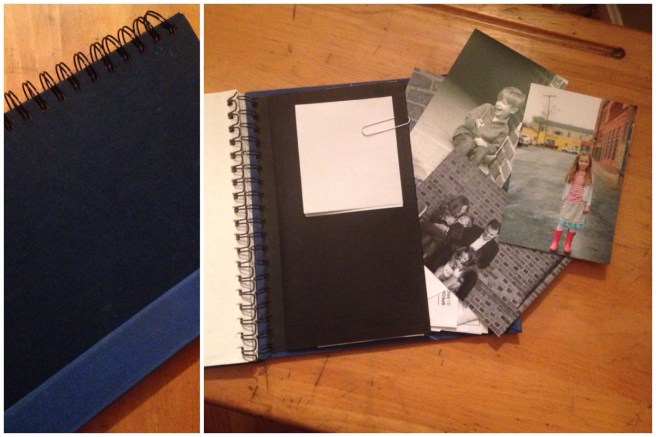
When it came to my cancer, I knew that I needed a notebook. I had a few qualifications. First and foremost, it could not be pink. I can’t emphasize that enough. There would be no pink. The next most important thing: it must be spiral bound. I am a voracious note-taker, and it’s hard to write things down quickly, neatly, correctly in a bound journal that won’t lay flat or let me flip around the used pages to take notes while holding it in my lap. This particular requirement nearly drove Sally nuts as we shopped. She is an artist, she studied graphic design. She loves pretty things. I wanted a lovely notebook, but I needed a spiral bound notebook. (That had no pink.) Sally showed me so many lovely journals at The Container Store and Papyrus. They really were lovely, but they weren’t spiral bound. I left Clarendon empty-handed and Sally headed home to pick up her kiddos from school. I hit every other shop I could think of before I had to leave for the bus stop. I was hopeful heading into Barnes and Noble, but struck out. Discouraged, I stopped in Michael’s to fill my final fifteen minutes, and I headed to the sketch books. I found it! Not a lovely floral or geometric print. Just an understated navy cloth covering, but it was spiral bound. The paper, while unlined, was a luxurious, heavy stock. Even better, this book had two features I didn’t know that I should have been looking for: a pocket and a magnetic flap closure. In that pocket, I could stick any papers from my appointments until I filed them at home. I kept prescriptions and orders for tests in that pocket so I would have them when I needed them. The best thing in that pocket? Favorite pictures of my kiddos and family, so that I could be a proud mama and show them off anytime a doctor or nurse asked about my kiddos. The magnetic flap closure held all those pictures and important papers securely inside.
Stay tuned– up next I’ll give you a glimpse into how I filled (and continue to fill) those heavy, thick pages.
You know those magazines that lay on the tables at your doctor’s office? I guess it’s more because of my stage of life, but I tend to think of all the pregnancy mags they have at an OB’s office. There’s a new one every quarter or so, except they all have essentially the same information, just repackaged for the next crop of pregnant moms. Apparently, they make these magazines for all kinds of conditions, and of course, breast cancer is no exception.
This Breast Cancer guide is published by Healthmonitor and is offered to patients for free in doctor’s offices. I was contacted by the editor who had come across my blog and was hoping that I would contribute to the upcoming issue. She had gleaned several things from my blog and used a few tips that worked into the issue. I sent her a few photo options, but I love that she used this one– it’s one of my faves from a session Sally did last May. For some strange reason, I really love that I can see my port scar just under my collarbone.
I’m sure it will eventually be available online, though for now, you could look for it when you head in for your annual mammogram! The editor sent me a PDF to preview this week. I have to admit feeling a bit starstruck (and a bit like a nerd!) when I recognized Shana of The Mom Edit (formerly Ain’t No Mom Jeans) on the page before me! She’s a fun mommy fashion blogger who I followed before she was diagnosed with breast cancer last year– though I must admit I followed more closely after her diagnosis.
I appreciated the opportunity to be a part of this project. I’ve been honored to write for the Arlington Magazine and to do the interview on Let’s Talk Live, but this magazine will put the name of my blog in front of actual breast cancer patients. I am humbled by the idea that newly diagnosed women, looking for any answer they can find in the stack of information they take home from the surgeon’s office, might read my words or head to my blog and learn something that will help them or give them a little extra confidence as they approach their treatment.
Perhaps the only picture taken of my while I was wearing my wig…
As I look back, I regret how I used this blog when I was going through treatment. It was more of a weekly check-in, just to let people know that I was still doing fine. Truth be told, sometimes I only checked in once a week because I was busy doing fun things and napping and just didn’t feel like spending my precious awake time on the computer. But still, I wish that I’d had more pictures of all the fun things I was doing– pictures of me in my favorite scarf and fabulous boots wandering around Old Town with Sally, pictures of me in my favorite smartwool hat from Athleta hanging out at the bus stop with all my neighbors, watching the kids play. Pictures showing that it wasn’t always all that easy, but that it really wasn’t all that hard, either. And I wish I had pictures of those few times I actually wore my wig.
I didn’t think that I wanted a wig, but it really seemed like it would be easier for the kids if I had one. Since insurance paid for it (or most of it), I went ahead and got one. I did my best to get one that looked like my real hair, but really only wore it to church. It felt so strange, so disingenuous to wear a wig over my bald head. I’ve also always been a “fusser,” I fuss with my hair constantly. I tuck it behind this ear, then that, smooth it out over my neck. Even with a good wig, that’s just not a great plan. It starts to get all tangly and before you know it, all I could think about was how much my hair felt like the hair on Emma Clare’s American Girl Doll. Not a good feeling.
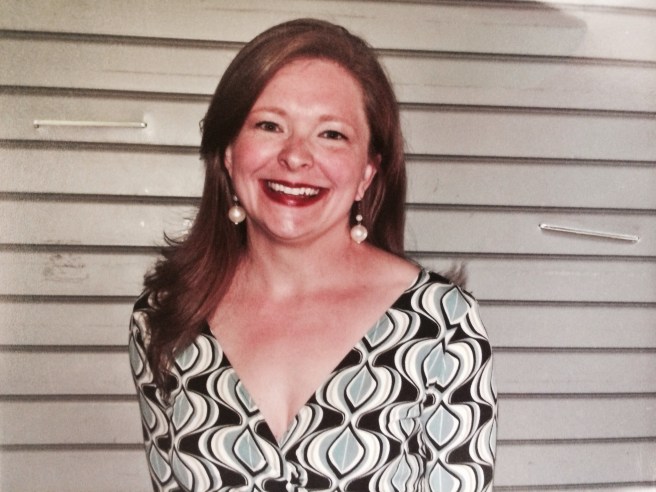
One Sunday, apparently the Sunday after chemo (I can tell because the steroids made me all flushed for several days), the youth director took photos of everyone to make a directory of sorts to hang on the bulletin board. As far as I know, this is the only picture of me actually wearing my wig, not just playing dress up. (Oh wait, I did find one other picture— even worse than this one– that I took the night after I had my head shaved.)
It was a really good wig, but I only wore it a handful of times. I think I somehow felt stronger without the wig– like I was showing that I was strong enough and healthy enough that I didn’t need the wig. That said, there are a lot of women who want to wear a wig for lots of great reasons. My kids didn’t mind me being bald, and I was so thankful for that. I have one friend, though, whose son found her bald head very upsetting, so she wore her wig most of the time. If I were working, especially in an environment where I dealt with clients, I can see wanting to hide my cancer– perhaps they might think I wasn’t up to the task or that they were “helping” me by taking their business elsewhere. If I thought I were going to wear my wig, there are definitely some things I should have done differently. A shorter, straight wig would be much easier to take care of and wear on a daily basis than the long, wavy locks I bought. If someone were trying to do the “wear the wig everyday and keep the cancer thing under wraps” thing, I’d probably suggest she cut her hair into a short bob as soon as possible– a style that would be easy to replicate with a wig. It was mere minutes into our first wig shop outing when Sally and I started referring to that as “weather girl hair.” I hope that doesn’t offend any weather girls. But seriously, watch the news for a while and you’ll totally get it. At any rate, if she’s got weather girl hair to begin with, when her hair starts falling out, a quick shave and a swap with the wig might not be all that noticeable.
It’s so funny to me that I desperately wanted to keep things normal for the kids, yet I thought nothing of showing up for a “normal” school event with nothing more than a scarf covering my head. Either way, especially when she has cancer, a woman should do whatever it takes for her to feel stronger, more beautiful, more powerful. She should do whatever she wants, whether that means having the best weather girl hair out there, or heading out with a shiny bald head and some great lipstick.




 Today was back to school day at our house. Thank goodness. Those kids needed to go back to school. For all of the learning, of course. As it turns out, apparently I had a little learning to do myself. (And yes, that’s the dog’s head. She’s missing her playmates. And driving me crazy.)


 Run Lipstick Chemo