On Faith and Faithfulness

After last week’s plea for a little inspiration, one of my cousins emailed, asking me how having breast cancer had affected my faith.  Whether I felt like my faith was stronger, or if I had grown angry with God and turned my back on Him. I have to admit I have felt a little disappointed that I didn’t feel like my faith really grew all that much.  I prayed, but not with the fervor that so many talk about when faced with such a potentially serious illness.  So when I got that email last week, I was reminded of my disappointment.  I figured I’d think on it and decide how– or if– I’d address the question.

On Sundays, my friend, Lucy, and I teach a group of high school girls, and last week’s lesson was on faith.  Only, it wasn’t on our faith, it was on God’s faithfulness. As Lucy went through the lesson and we all discussed, I realized something. Cancer didn’t necessarily teach me anything about my own faith, but it taught me something about God’s faithfulness.  He is faithful to us even when we are not, even when we can’t see what He is doing.  I won’t be so dramatic to say that everything that happened in my life before the cancer diagnosis was preparing me for that moment.  Yet, I can see so many ways that God made sure that I was ready when I heard those words.

Of course, there is the whole graduate school thing.  When I applied to graduate schools, I really thought I would be in an immunology program.  Only I didn’t get into the immunology program at Hopkins (my first choice) and the program at Georgetown (focusing on oncology, where immunology was only a component of other courses) was so much more attractive than the program that had accepted me at Maryland.  And so, I ended up knowing so much more about breast cancer than the average patient.

Then there’s that lump.  That first lump that I found shortly after starting at Georgetown years ago taught me so much about how doctors deal with a young woman who feels a lump in her breast.  Mostly, it taught me that a breast surgeon would be the only one who could definitively address my concerns, so that might as well be my first call.

I didn’t start running until a couple of years ago.  Before then, I’m embarrassed to say that I was pretty much a couch potato.  My oncologist stressed that during treatment, and especially now that treatment is complete, physical activity is so important.  But I’m betting that during chemo isn’t the optimal time to take up running.  I was so thankful that running was already a part of my routine, so that even though I ran less during chemo and have had a hard time getting back to full force post-surgery, it still seems natural and like something that I want to do.

Oh, and the friends that God has put in my life.  Of course, Sally has been, as Clay’s mom says, “the best friend you could ever ask for.”  I’m thankful for all those at our church who prayed for me and drove, frequently more than an hour round trip, to deliver meals to my family.  Really, though, one kind of expects at least some of that support from a church. But I was also so blessed by my neighbors, the way they rallied to bring us food, watch the kiddos, and chat with me about whatever I needed to chat about.  When we moved into this house years ago, I had no idea how very important the location would be.  I was even grateful the ill-fated camping trip we took with our neighbors just a few weeks before my diagnosis when we lost Turner in the dark campground for at least ten minutes!  It gave our family, and especially Clay, who doesn’t spend as much time at the bus stop, such a great opportunity to get to know these families better.

So many more things I could add…  The fact that my tumor for some reason spawned a cyst that allowed it to be palpable years before I’d have a mammogram… The friend of my daughter whose mom introduced me to another woman whose friendship has been so important to me this past year…  The scarf that happened to be in a swag bag and became my go-to head covering… The fact that I didn’t get around to finding a job to start as soon as Turner headed to kindergarten…  The fact that I’d followed Ashley all through her cancer journey and knew how I’d want to deal with my own hair loss…  Our house, with all those fabulous neighbors, happened to be just a mile from a top-notch breast cancer center… The first time I’d heard from my graduate school mentor in nine years was just after my surgery and she was able to help my get involved with the patient advocacy group at Lombardi…

I quickly realized that God knew what my body would have to go through, and I prayed simply that He would make my body strong. But not until this week did I realize that perhaps it’s not all about me.  Maybe I didn’t need for cancer to teach me anything about me and my faith.  Maybe I needed cancer to teach me some more about God and His faithfulness.  Not only did He know what my body would need to go through, He knew everything I and my family would have to go through, and He was faithfully making us ready all along.

You Asked: Lymphedema and Cording

So I’m taking a small liberty here, no one asked about cording, but it feels like it’s worth mentioning along with my comments on lymphedema.  To determine the spread of breast cancer, breast surgeons remove one or more lymph nodes.  They act as filters, so they are likely the first place cancer cells would be trapped if they’d escaped the breast.  Unfortunately, taking them out to check for cancer, while important, can cause not so great side effects.  Lymphedema– the swelling of fingers and arms in breast cancer– occurs when the remaining lymph nodes can’t keep up and fluid builds up.  That’s why some women wear a compression sleeve after a mastectomy. Because some of the lymph nodes are removed, the lymphatic vessels that service those nodes can harden from disuse and cause problems as well. (They look like tendons that appeared out of nowhere, frequently under the arm and down the arm to the wrist, but can also run from under the arm and down through the chest.)

Before I had my mastectomy, I had an hour or so consult with a physical therapist.  (As an aside, I would insist on having this kind of appointment a week or so before surgery– invaluable.) Michelle is a lymphedema specialist, and she made sure I understand exactly what I should and should not do after surgery.  More than that, she made sure I knew what to expect and what would signal a problem with lymphedema.  She emphasized that it would be far easier to deal with lymphedema early, before it became a significant issue.  Though I have yet to meet her, I also have several friends who see a massage therapist at the Teal Center at the hospital who focuses her massage on the axilla (that’s a fancy word for armpit– I’m flashing back to Fancy Nancy!) to help encourage lymph drainage.

Thankfully, I only had a few small, superficial nodes removed at surgery, so I am not likely to struggle with lymphedema. I did experience some minor cording, and Michelle used massage and stretching to break the cord, which you could hear pop as she broke them down.  Creepy.  On the advice of a friend, I scheduled my appointments with her just before I went for an expansion with the plastic surgeon, and I think the relaxing of that area really helped lessen the pain of the expansion.

Lymphedema and cording are real issues, though as current standard practice does not dictate that a surgeon remove all  nodes, they are not as prevalent now as they once were.  Still, the take home message is that there are physical therapists who are specifically trained to combat these problems.  Michelle did a great job, and she was really nice, too.  A little PT would be so much better than dealing with swelling and the pain from cording.

Writer’s Block

I have to confess I have a bit of writer’s block.  I can’t seem to think of a topic to get me started.  So that’s where you come in.  Any burning questions?  Something you’d like to know about implants, chemo, doctors?  I’m sure there are lots of things that I’ve forgotten to mention or skipped over because I thought they weren’t interesting.  I mentioned it before, but questions don’t bother me.  I promise, you’re more embarrassed to ask than I am to answer.

Come on, help a girl out.  Submit questions in the comments, or if you want to stay anonymous, just drop me an email.  Would love to hear what’s on your mind!

On Receiving a Compliment

I’ve been thinking a lot lately about how I react when someone pays me a compliment, I think graciously accepting a compliment is so important.  And if I want Emma Clare to have a healthy body image, I can’t constantly belittle myself when someone says something nice about me.  Over the summer, we had the opportunity to visit family, seeing many who I hadn’t seen in a year or more.  The last time they’d seen me I had long hair and no scars, visible or otherwise.  (That pesky port scar is pretty visible when I wear tank tops and summer dresses, though to be clear, I really don’t care who sees it.) Most of the friends and family had followed this blog and Facebook during my treatment, so they’d seen pictures of me along the way.  It was almost amusing to me the way, to a person, they all said that I looked great.  I mean, again, a compliment is always wonderful, but it was almost like they didn’t expect me to look good– despite the pictures and the words I’d written, they expected me to look gaunt, sad, sick.  And so for every nearly identical compliment I received, I replied in an identical manner.  “Thank you, I feel great.”  They didn’t want me to belittle myself, commenting that I sometimes wished I’d lost some weight during chemo instead of staying so “healthy,” that I missed my long, lovely locks, or that I hated the tissue expanders that were interrupting my sleep.  They wanted to tell me that they were happy I was healthy, and  I decided to let them know I was happy to be healthy, too.

Running Towards “Normal”

Sally saw a post last week  and the photos alone gave her an idea.  So she gave me my very own photo challenge.  She suggested I bring along my camera on my first run after this last surgery.  She thought maybe I could document my run as I “get back to normal.” I love that she quickly added. “Ha.  Like normal is a thing.”

run lipstick chemo breast cancer

I agreed it would be a fun post, and so after lacing up my running shoes, I snapped a photo on the brick stairs at my front door, and I continued to snap away as we ran along the Potomac.

run lipstick chemo breast cancer

run lipstick chemo breast caner

run lipstick chemo breast caner

run lipstick chemo breast caner

run lipstick chemo breast caner

As I haven’t been on a run at all in six weeks, and I was only running half heartedly at best before that, I welcomed any stop to take photos.  So did this little lady, who was eager to pop out of the stroller at any opportunity.

run lipstick chemo breast cancerAnd of course, no fun run with Sally would be complete without the requisite stop at Starbucks.  So glad to be running and getting back to normal.  Like normal is even a thing.
On Finding a Lump

So despite my mini-rant on the pinkwashing of all kinds of stuff to sell in October, I’m all for breast cancer awareness.  But I’m thinking if you’re reading this, you’re plenty aware.  And surely you know that a woman over 40 needs a yearly mammogram.  If your doctor finds something suspicious on a mammogram, then it’s pretty easy to know what to do.  Whatever the doctor tells you.  But if you’re like me, under 40 and not yet a candidate for a mammogram, or if you’re in between mammograms and find a lump, it’s a little harder to know how to proceed.

The first time I found a lump, it was under my arm, probably twelve years ago.  I did what I would guess most women do.  I worried, let my imagination go off the deep end, and hoped that it would just go away.  After obsessing for several weeks, I made an appointment with my primary doc.  Because I figured that was the thing to do.  The lump was obvious, and being under my arm, I was sure I had breast cancer which had spread to my lymph nodes– stage 3 at the best. My doctor, on the other hand, was sure I was recovering from some sort of an infection, and that if I took some Advil, the inflamed lymph node would return to normal in four to six weeks.  After a couple of weeks, I’d had no resolution, and so I made an appointment with my OB/GYN. She, too, was sure that it was nothing, but if the Advil didn’t take care of it in another four to six weeks, she gave me the name of a breast surgeon to contact at that point. As soon as I left her office, I called the surgeon. No sense waiting any longer. A couple of weeks later, at the first available appointment, I met with the surgeon.  He, too, assured me that it was probably nothing, but wanted to be sure and sent me for an ultrasound.  An hour or so later, I was returning to the surgeon’s office with a little black and white print out– an ultrasound pic of a glob of fat in your armpit isn’t nearly as adorable as one of a teeny little baby, by the way. Turns out, they were all right, it was nothing and I was fine, but it took a trip to a breast surgeon to know for sure.

Strangely, I’m so thankful for that experience. Last year, on that Saturday, when I first felt that lump in my left breast, I knew immediately what I needed to do.  The surgeon who I’d appreciated all those years ago is no longer in the area, so I made a short list of surgeons to call Monday morning.  I was fortunate to secure an appointment for the very next day, and she did an ultrasound and aspirated the cyst right in the office.  I was out and on my way within a half hour.  And within the week, I had a diagnosis.  Waiting a few weeks and jumping through a few hoops probably wouldn’t have made a difference in my long term outcome.  But because of some previous procedures, I had an appointment with my OB/GYN and a general surgeon who sometimes does breast surgeries in the following weeks, and they both indicated that they don’t always even aspirate cysts, and they certainly don’t send the fluid to pathology. I definitely made the right call. A breast surgeon is a specialist for a reason, and I can’t think of a better first call after finding a lump.

Pinkwashing

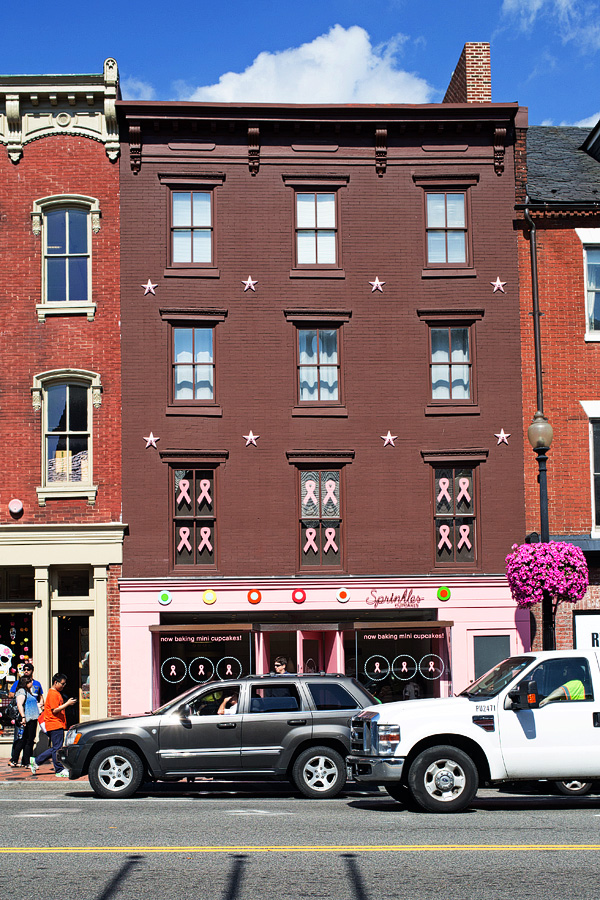
sprinkles pinkwashing run lipstick chemo

Happy October, all.  Last year as the nation “celebrated” breast cancer awareness month, my friends, family, and I became acutely aware of breast cancer. To anyone in the throes of a new breast cancer diagnosis, I sympathize with you. October must be the worst time to be diagnosed with breast cancer.  Yes, Yoplait, I am aware.  Yes, NFL, those big guys do look a little silly in pink helmets.  Yes, 5 hour energy, I have heard of breast cancer.  (5 hour energy, really?  Still don’t quite get that one.  I’d think that stuff would give cancer to mice for sure.) Back in my days in the lab, I thought the idea of saving, washing, and mailing in pink yogurt lids was laughable.  Why not just write a big check and be done with it, Yoplait? Why do I have to do all that work? And all the athletes in their pink gear?  I was outraged that they spent the money on that gear and didn’t just donate it to a good cause.  Then my husband informed me that they auction them off and donate the proceeds, and apparently people will pay a premium for sweaty game-worn gear.  So there’s that.

But still, I can’t help but feeling like all the companies that are slapping a pink ribbon on anything they can think of are capitalizing on a life threatening disease.  Maybe it’s just an emotional reaction, and I know plenty of “survivors” who love them some pink ribbon swag. But I can’t help but feel a little dirty thinking of the money companies are making schilling all their pink products.

That said, I think money for education is fine (though are there really women who don’t know they should get yearly mammograms?) and I think money for research is great. I’m partial to Komen and Avon, as I’m familiar with their granting mechanisms and I know they stand behind strong science. I know there are plenty of products– good products, things I might even like– that donate a portion of their proceeds to some worthy breast cancer cause.  But really, it’s just a portion, and it’s rarely more than a dollar or two for each item. (That 5 hour energy? Five cents per bottle.) I’ve been trying to come up with an educated position on this issue, I don’t want it to be emotional on any level.  And so I’ve decided.  If I really like that pink ribbon lipstick/blush/yogurt, then I’ll buy it and be happy that they’re giving a small donation to a good cause.  But if I feel like I need to support a good cause and like a different lipstick, then I’ll buy the lipstick I want and send my two dollars to Komen on my own.

Being Your Own Advocate

When it comes to health care, you really do hear it all the time.  “You have to be your own advocate.” While I don’t condone spending all your time self-diagnosing on the internet and then searching for a doctor who agrees, I do think that you need to know your body.  You know when something’s not normal and should make sure that your healthcare team gives it proper attention.  But today, I’m speaking more in the customer service realm. The survivorship appointment that’s been repeatedly rescheduled was finally on for Tuesday.  (I should say that very few oncologists even offer this type of appointment, so I was excited at the opportunity.)  Every time my phone rang with an unfamiliar number in the preceding week, I figured the appointment was off.  Just to be sure, I even called to confirm Tuesday morning before leaving the house.  I showed up early for my 9am appointment and was called back to get my vitals taken a little after 9.  Then at 9:25, the nurse who’d taken my vitals came in and shut the door behind her.  Uh-oh. There was a problem, she said, could I reschedule my appointment? Maureen’s schedule should have been blocked, someone made a mistake. No, I could not reschedule, I told her.  As respectfully as I could, I explained the difficulty I’d had getting this appointment scheduled, and asked if Maureen was in the office. There was some back and forth as she left the room to figure out what to do, and finally at 9:45, it was decided that Maureen could see me at 10.  Was that OK, the office manager who was in listening to my concerns asked? “No, it is not OK.  I will wait for 15 more minutes because I’ve already wasted so much time on this appointment, which I think is important. I’m betting many patients would have given up by now and abandoned this all together.  I will wait.  But not because it is OK that you have made me wait.”

I was pretty livid at the way it was handled. I don’t know who is at fault, and it doesn’t really matter.  I made sure that my concerns didn’t go unheard.  More than that, I’m not embarrassed with the way I handled it, I was respectful but firm, and in the end, I got what I needed. And I learned a very important lesson of exactly what it means for me to be my own advocate.

Breast Cancer and My Kiddos

kiddos breast cancer

I met a young woman last week who was diagnosed with breast cancer a few months before I was and so we instantly started talking about our shared experiences.  Being moms, chemo, baldness, those wretched tissue expanders…  But as we chatted, she said something that left me speechless.  (And this blog would indicate that I am rarely speechless!) She hadn’t told her kids that she had breast cancer.  They range in age from preschool to upper elementary school.  I couldn’t imagine trying to keep that up– making excuses for missing out on activities because of doctors appointments and fatigue, explaining why people were bringing us dinner, hiding a port, scars, post-surgery pain…  But most of all, it exhausted me to think that she couldn’t let her kids know that she was bald.

That’s not the way we decided to handle it for our family.  Let me make it clear though, the way we handled it was definitely the best way. For OUR family. Not the best way for her family, she needed to make that decision, and there’s no way that I would judge her or try to tell her that she did it wrongly.

But it did get me to thinking.  There are probably women who struggle with how to talk to their children about their cancer diagnosis.  Or whether to talk to their children.  And when we had that conversation with the kiddos a year ago, it was a very raw time for me.  That fell into the category of things that I just couldn’t blog.

We decided to wait until we knew for sure the treatment course, I wanted to be sure that the kids got the full information when we had that conversation.  We wanted them to hear the whole story the first time. So once we knew for sure that I would have chemo and then surgery, we sat down with them.  I thought that it was important that we were honest with them and answered their answered their questions truthfully, but I know that there is such a thing as giving kids too much information.  Answer only what they ask, no more.

So when we sat them down, I reminded them that I’d had a couple of doctor’s appointments that week.  Then I told them that the doctors told me I had breast cancer.  Emma Clare gasped. Turner immediately said, “So you’re going to die, right?” Insert knife into heart. As quickly and as confidently as I could muster, I answered.  No. I explained to them that cancer is when some normal cells go out of control and don’t stop growing when they’re supposed to.  If the cancer cells get to an important part of a person’s body, that can make them die.  But my cancer was in my breast, and while they were important for feeding my babies, I didn’t need them to live. So I was going to have to take some pretty nasty medicine to kill the cancer that might make me sick and would make my hair fall out, and I would have surgery so that they could take out all the cancer in my breast.  But the doctors would do their very best to kill all the cancer and then make sure that I felt and looked as good as new when it was all over.  They didn’t love the idea of me being bald, and they really didn’t like the idea of me having to stay in the hospital overnight when I had my surgery.  But after we talked, I had several weeks before chemo started.  They had time to process, ask questions, and get used to the idea. They talked about it with us, with their teachers, with their friends. I think being able to talk about it made it less scary, little by little. By the time they went with me to have my head shaved, they were excited about it, and months later, they were even ok with the surgery, too.

I won’t say that we handled it perfectly.  I won’t say that it was easy. I cried a little.  I was honest and told them I was scared, too. (Maybe I should have been stronger?) At one point, Clay had to take over because my heart was broken, and so was my voice. But we told them that we had so much confidence in my doctors, and more than that, I was confident that God had a plan for me and for our family, and we would come through it all fine.  Believe me, just this week, I’ve had a couple of doses of reality.  Cancer isn’t pretty and pink, it isn’t easy, it doesn’t always have a happy ending, and my kids might not have the most realistic perspective of how bad it can get.  But you know what? I’m totally ok with that.  They’re just kids. They can grow up later.

In Case You Missed It | Alexandria Stylebook

In case you missed it, I did a guest post last week at Alexandria Stylebook.  I got to play dress up with such nice clothes, lovely jewelry, and fabulous shoes.  After shopping at Zoe Boutique, Kiskadee, and The Shoe Hive, I met with Allison at Bellacara to have my make up done before heading to a studio photo shoot with Sally.

alexandria stylebook run lipstick chemo

I had the opportunity to share my story with a new group of people and talk about why lipstick (and taking time to look my best) was so important to me, and it was such a fun day, too.  Many thanks to the ladies at Alexandria Stylebook!  Head there to read my post.