This Will Be the Year | Nike Women’s Half Marathon

2014_nike_women_header

Last fall, as I sat in the initial consults with my doctors, I imagine they were surprised by my questions. I wonder if they thought I was in denial as to what I was about to go through. In fact, maybe I was in denial. I remember asking my oncologist if she thought I would be able to run a 5K with Emma Clare days after my second chemo infusion. I didn’t ask whether my hair would fall out, how severe the nausea might be, or whether my immune system would be so compromised that I shouldn’t go to the kids’ school on occasion or to church every Sunday. I wanted to know if I could run. Emma Clare and I had planned to run that race, and it was (frankly, probably inappropriately) important to me that I run it. Breast cancer was not about to take that experience from me.

Earlier that fall, Nike had teased the announcement of their inaugural half marathon in Washington, DC. Sally and I had decided we would enter the lottery to run that race in the spring. Having met the authors over the summer, I had my autographed copy of  Train Like A Mother already dog-eared to a training program and was looking forward to the race. In my initial consult with my surgical oncologist in October, I was already asking whether the prospective surgery dates would allow me to be recovered in time to run the half marathon. And I remember standing outside Ray’s Hell Burger, while my parents and brother ate inside with Sally, talking on the phone to Cami from my plastic surgeon’s office. I listened to her lovely French accent as she informed me that I would not be ready for a spring half marathon.

I’ve been having a hard time getting my mojo back when it comes to running, I’ve gotten a little too used to sleeping until 7! But perhaps making the cut for this year’s Nike Half Marathon is just what I need. I am now officially registered to run the race.  Breast cancer took away my 2013 half marathon goal, but this is my year to make sure that breast cancer doesn’t steal that goal completely. Perhaps I need to look at this race the same way I looked at last year’s Girls On The Run race. I planned to run this race, and I will run it.  Breast cancer may have delayed my plan, but it can not take this experience from me.

And so I’d better finish this post and get to bed. I’m going to need to get up early tomorrow. I’ve got some running to do.
Expect the Unexpected | Being the Comforter

I feel like there could be a series here, though I’m not sure what the other posts might be.  Guess you’ll just have to stay tuned…

So I’m sure that most people think that when someone is diagnosed with cancer, they are devastated, an emotional wreck. Now, that is one possibility, and there’s nothing wrong with that.  And we tend to think that as a friend or relative, it’s our job to comfort them.

Tonight, I was watching the Hawaii Five-O episode from last week. Carol Burnett was guest starring, and she had just been diagnosed with a brain tumor. As she told her family of her diagnosis, I was instantly taken back to a year ago. With only a very few exceptions, by the time I told anyone I had cancer, I had cried my tears.  I knew what needed to be done. I had turned off my emotions and I felt like I had as much control of the situation as was earthly possible. I was surprised at how often I found myself, dry-eyed, hugging and comforting my teary-eyed friends.  Seeing it play out on TV reminded me that these friends were taken by surprise by my news.  They hadn’t had the time to cry their tears, and they hadn’t been with me in the doctors’ offices to hear their reassurances. They felt helpless and were looking to me for reassurance, they wanted to hear me say that I’d be ok.  As strange as it felt when I hugged that first crying friend, I quickly realized that it was normal.  It never bothered me to hug and reassure my friends, in fact, it was probably a good exercise for me to hear myself say over and over again that I would be ok.  Because even though I felt like I had things under control most of the time, I could probably use a little reassurance, too.

Dance if You Want To

I’m betting lots of you have seen the video of the woman dancing in the operating room before her mastectomy. In fact, a few of you have sent it to me! Strangely, I didn’t think much about it, except that I’ve never had a surgery where I was awake in the OR.  They’ve always given me some nice meds in the IV so that I don’t last much longer than the time it takes to get out the door of the pre-op room.  Why was she still awake, I wondered?  And weren’t they worried about the sterility of the environment?  Of course, she is an OB at that hospital, so I imagine she might have been given a little leeway to do what she wanted.

I hadn’t thought anymore of it until I ran across this article last week.  “You don’t have to dance at your mastectomy,” the author wrote. And so I started thinking.  Everyone deals with things differently.  Deborah wanted to dance, it was her way of showing her friends, her family, herself, that cancer wouldn’t beat her.  And that’s ok. But the author of this article cautioned that it’s ok if you don’t want to dance, too. It’s ok if you want to be scared or sad or angry.

It almost made me feel a little guilty.  No, I didn’t have a flash mob in the OR when I had a mastectomy.  But I do try to keep a positive attitude, and make light of the whole cancer thing whenever I can.  I don’t put a lot of sad or angry on this blog, though honestly, that’s because I don’t have a lot of sad or angry to share.  But just because I’m not sad or angry doesn’t mean that I’m better than someone who is. It doesn’t make me stronger or braver.  It just makes me me.  So you be you, and dance if you want to.

On Not Having Cancer

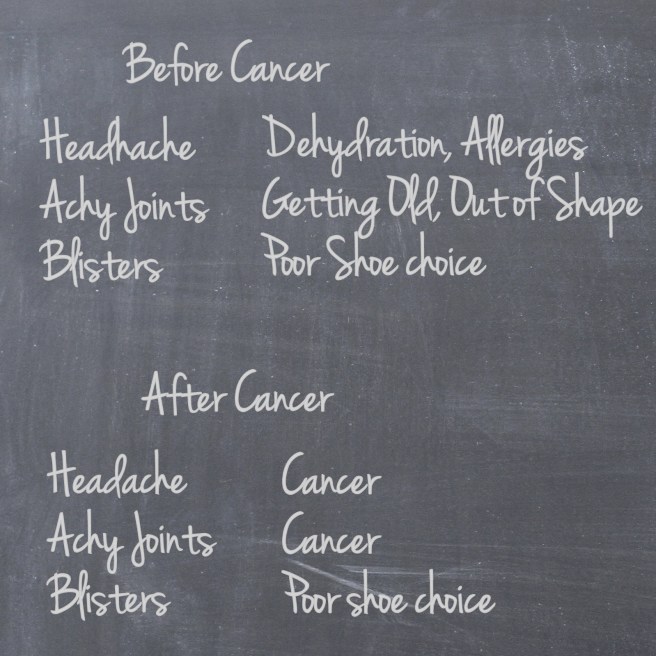
If you thought having cancer was hard, you should try not  having cancer. Before cancer, little ailments were just that.  Little.  Easy to explain.  During treatment, everything  was chemo’s fault.  After cancer, no matter how hard I try, one thought creeps back in…

before and after

Don’t get me wrong, I don’t obsess over cancer coming back.  Thankfully, I’m far more logical than I am emotional. So every time cancer creeps into my mind, I can convince myself pretty quickly that normal is normal.  I have a wonderful oncologist who has made it very clear what constitutes “more than normal” and requires an office visit.  And I know that she will listen to any concern I bring to her, no matter how irrational, with the utmost compassion and professional courtesy. But I can’t say that I’m not looking forward to the day when I am confident that my headache is just PMS.  At least I know that the blisters on my toes are my own fault.

On Choosing a Plastic Surgeon

Those first two weeks after I was diagnosed with breast cancer, I went to a flurry of appointments.  There were quite a few diagnostic and follow up procedures, in addition to appointments with my surgeon, my new oncologist, and two different plastic surgeons.  At the time, I’m sure I would have downplayed the importance of choosing a plastic surgeon.  Perhaps my surgeon knew that, and that’s why she insisted that I meet with at least two before I settled on one.

I am certain that I made the right decision when I chose my surgeon.  I imagine if you’re searching out a plastic surgeon for botox or a tummy tuck, you’re either prepared to feel a little vain, or it’s just not something that you even worry about. But if you’re like most breast cancer patients, it can be a little awkward to go into a doctor’s office asking lots of questions about how great you’ll look after he does his job.  I mean, you just want to survive the cancer, right? It shouldn’t matter if you come out on the other side with a great rack.

This is just one place I think my surgeon was great.  He made it very clear from the beginning that he does lots reconstructive surgeries (a must!) and wanted to be sure that I thought I looked good, period, not just good enough  for having had breast cancer.  He showed me pictures of women who had made all different choices– you might be surprised all the choices someone in this position actually has.  Bilateral mastectomy, or single with a lift on the healthy side to maintain symmetry?  Nipple sparing, nipple reconstruction, 3d tattoo? Stay the same size or go bigger?  He was at the same time realistic and optimistic about my outcome.  Not only did he want me to be happy with how I looked, but he wanted to be sure that  he  was happy– that I looked natural and not like some over-done Hollywood B-lister.  Since there is no fat or breast tissue left after a mastectomy, implants alone can end up looking pretty fake, so he uses fat grafting to fill in around the implant.  This means that during the surgery I had liposuction (not enough to really make a difference, though, don’t get excited) and he injected that fat around the implant, giving a much more natural look. He was also very thoughtful about the incisions, making sure that my scars won’t be visible should I wear even a pretty skimpy bikini top.

Being able to talk easily and honestly is so important, this is a doctor who I saw several times a month.  He not only made sure that he answered my questions, but always remembered the name of my husband or what ever friend came along with me, and called them by name when asking if they had any questions. We talked about lots, and as we neared the end of my expansion, I remember him asking if I’d tried on some of my dresses to see if I liked the way they looked, or if we needed to expand a little more.  He managed to find a way to let me tell him what I wanted without forcing me to outright ask for bigger boobs.  And after the final surgery, he honestly wanted to know what I thought, to be sure I happy with the size and symmetry.

Sure, these aren’t the life and death decisions that the oncologist makes.  But when you’re considering a doctor with whom you have to be painfully honest in some painfully vulnerable situations, and who is in control of how you feel about yourself every time you look into the mirror, it’s worth taking the time to make a good decision.

Dreading the Mammogram | Amy Robach Diagnosed with Breast Cancer

Good Morning AmericaPhoto By Ida Mae Astute/ABC
Good Morning America                                                                    Photo By Ida Mae Astute/ABC

Like many today, I read the words of Amy Robach, the ABC News Anchor who was diagnosed with breast cancer last month after an on-air mammogram.  She wrote of being approached by a producer pitching the segment and described the proposed mammogram as, “something I really didn’t want to do, something I had put off for more than a year.”  She is 40, the age at which it is suggested that women begin getting mammograms.  And yet she had put it off.  Like so many women, she avoided it.

Sally and I were talking this afternoon, and we wondered, why do so many women put off their mammogram?  Admittedly, there is some pain associated with the exam.  And yes, it takes some time out of your schedule.  I’m struggling to remember how long it took, I think I had an MRI right after mine (now that’s a real time suck) and we were still out in time for lunch.  So it’s a little bit of pain and less than a morning of your time.  It’s not really the pain, and it’s not really the time.  It must be the fear.  Even knowing that most women who have a mammogram have no malignancy.  It’s as though the fear of what we might possibly discover takes over and convinces us, subconsciously, that it’s better not to know.  I imagine it’s the same reaction many women have when they find a lump in their breast.  (I’m so glad that first lump that turned out to be nothing taught me what to do when I felt the real  lump last fall.)  And yet, I’ve never met a woman diagnosed with breast cancer who wished she just hadn’t found out, who wished she’d been diagnosed later.

I know plenty of women who’ve had nothing but normal mammograms, and most complain about them– hating to get them done. (Though, to their credit, they get them done anyway.) But as a woman who’s had breast cancer and is looking at it in the rear view mirror, I can say with confidence that you gain nothing by waiting.  It really isn’t better to just not know.

And to Amy, and to any other newly diagnosed women, I can only leave the words a friend of mine offered me after my diagnosis. They meant a lot to me because a few years prior, she’d been in the same spot, looking at her two beautiful children, facing chemo, surgery, uncertainty.

You’re stronger than you think.  You can do this.

Pixies by Choice

redlipstick-102
A few days following my most recent haircut wearing Russian Red lipstick by MAC

charlize          michelle williams

beyonce 2                   pam anderson

jlaw

Charlize Theron was one of the first celebs with whom I related when my hair was growing back in.  I still love her hair in that first picture– she is so beautiful, and her hair just looks perfect to me.  And of course, Michelle Williams has been sporting her pixie ‘do long enough to be one of the first images that pops up when you google it.  Beyonce chopped off all her hair this summer, but I have to admit being a little disappointed when she was photographed in a long wig just a few days later.  And just this week, Pamela Anderson ditched the long locks that have been a major part of her identity for decades, and Jennifer Lawrence followed suit.

It’s probably easier to keep up with a pixie hair cut when frequent haircuts are de rigueur and a stylist follows you around with an armload of product, ready any time a hair goes awry.  And of course, when they’re ready to grow it out again, they’ll have the support of that same fabulous stylist, helping them make the best of a hard hair situation.  I’m so glad that I have Dragan by my side, helping me as I try to grow mine out.  I love it short, but I loved it long, too, so we’re going to see if I can stand to let it grow.  But at least I know that I’m in the very best hands, or scissors, to make the growing out process as painless as possible.

photos: Charlize Theron/Michelle Williams/Beyonce/Pamela Anderson/Jennifer Lawrence

Missing Cancer | Scarves

covet14-100

A couple of weeks ago, Sally and I were at one of our favorite shops, Covet Boutique in Arlington, getting ready for a party we’re helping host this weekend.  I saw this scarf on a display and loved it.  I was so disappointed that Autumn, the shop owner, hadn’t found these last year.  Even though I’ve got hair now, I couldn’t resist tying it on my head, wishing I’d had it a year ago.  I love everything about this scarf– the soft, knit jersey, the red color, the chevron pattern, the long tail, the contrast of turquoise and navy.  As I recall, there was another print or two of these soft, knit scarves, but I can’t even remember what they look like, this was so clearly my favorite.  It almost makes me miss the bald head that required a scarf. (And if you happen to be local and would like to join us this Saturday afternoon, you can check out this scarf and the rest of our favorite gift shop– details here.)

This post is part of a series of what I’ll miss from my time as a cancer patient.  I know cancer is a serious thing, not everyone tolerates treatment well, and not everyone recovers.  I don’t mean to offend by making light of a serious subject.  These posts are just a glimpse of my efforts to make the best of my situation—to find the silver linings wherever I can.

Follow Up

follow up

Last March a week or so after my mastectomy, I had an appointment with my oncologist.  While I’d already heard from the surgeon’s office that I’d had a complete pathological response, this appointment had been set up to completely discuss my pathology and any next steps.  Because of the good pathology news, the “next steps” part was very short.  Come back every six months for a quick physical exam and a chat with her.  And that is all.

I love my oncologist, and I respect her on top of that.  But I questioned this advice.  Nothing? No scans, no blood tests, nothing?  Knowing my research background, she reassured me what I suppose I already knew deep down.  I don’t have any breast tissue left to mammogram.  There are no biomarkers associated with breast cancer that can be measured from a blood test.  And even PET/CT scans aren’t indicated in an asymptomatic patient.  She told me that the Journal of Clinical Oncology had recently published a study on this very topic.  So we discussed that I’d be back in six months, and the situations under which I should call her earlier, and I hugged her and left.  I was a little surprised to see an email from her in my inbox later that afternoon, with this article.  She’d found the article published that very month, and sent it to me to reassure me just a little bit more.  And when I admitted to being a bit of a nerd, but told her I appreciated her taking the time to send it to me, she replied simply.  “nerds are cool :)”

More Questions | Mammograms

show-2
source

First a disclaimer: I’m not a medical doctor. This blog is full of personal anecdotes and sometimes a scientific perspective.  So, there’s that.

The American Cancer Society encourages women to start annual mammograms at age 40. (A newly-Canadian friend asked about this, and I believe their recommendations are a bit different.)  Because of that recommendation, insurance companies are required to cover this level of screening. Doing a little research for this post, though, I found that in 2009, the US Preventative Services Task Force actually changed that recommendation to start biennial (every two years) mammograms at age 50, but I’m guessing that because of previous legislation, insurance companies still cover yearly mammograms after 40, and so doctors still suggest it.  (Not only am I not a medical doctor, I’m not a politician, so if I’m wrong, please forgive me.) If a woman is at particularly high risk, earlier screening may be warranted.  In general if your parent were diagnosed with a  (screen-able) cancer at a young age, you should start screening when you are ten years younger than your parent was at diagnosis.  So that means based on current standards, my beautiful little girl will need to start some breast cancer screening when she’s only 25.  That really breaks my heart.

Even for women with reasonably normal risk, though, mammography is not without controversy.  There is a growing voice speaking out against screening mammography, citing data indicating while it has increased the instance of diagnosed breast cancers, it has not drastically decreased the number of breast tumors presenting at a late stage, nor has it made a significant decrease in overall mortality.  (Edited to add: a new study refutes this, indicating that mammograms really are catching tumors earlier.  Read my update to the great mammogram debate here.)  And they suggest that the number of unnecessary biopsies is not acceptable.  Now, I’ve had a diagnostic mammogram, which is like a screening mammogram on steroids.  Yes, it hurt.  But for a few seconds a few different times.  And I’ve had a few biopsies.  One of them was particularly bad– I bled a lot.  My chest was wrapped so tightly when I left that I couldn’t fully inflate my lungs, and the surgeon called me first thing the next morning because she was so worried that I might start bleeding and require emergency surgery. That was a bad biopsy. Still, I’d rather have a bad biopsy and find out that I didn’t have cancer than let cancer go undiagnosed for years.  That’s all emotional, of course.  I’m so glad I’m not the one who has to really examine the data and look at cost benefit analysis to make official recommendations and decide on insurance coverage.  But my semi-emotional, semi-rational response?  Get your mammogram for as long as your insurance covers it.

On the other side of the issue, there are people who wonder why mammograms are only covered for women over 40.  I mean, I got cancer before I was 40.  Breast cancer is still predominantly a disease of older women, and yet that doesn’t mean that young women go unaffected.  But part of the reason that younger women don’t get mammograms has to do with their biology.  Younger women have denser breasts– more breast tissue and less fatty tissue– and mammograms can’t visualize a dense breast nearly as well as a fattier breast.  So a screening test that’s not as effective in a population that’s at a much lower risk? Not recommended.  For young women at particularly high risk, those with a mutated BRCA gene, for example, an MRI can often be more informative and so is more likely to be covered by insurance.

I don’t think any woman can say the word, “mammogram,” without cringing just a little.  But one very important thing I’ve learned in the last year is that it’s SO much better to find a tumor sooner than later.