On Being an Advocate

Georgetown University

I’ve been meaning to write this post for a while, and somehow I have a hard time finding the words.  Perhaps it’s because I’m just beginning my journey as an advocate, learning what it means.  So I did what anyone in my position would do, I googled it.  Defining an advocate as one who supports or promotes the interests of another seems to make the most sense.  So specifically, I want to support the interests of breast cancer patients– I want them to understand their disease, their treatment options, and the ways their life will be different during and after their treatment.  But I also want to support the interest of breast cancer researchers.  Good research, after all, will ultimately be of benefit to the patients.

The best way that I can see to support patients is on an individual basis.  This blog has allowed me to reach out to newly diagnosed women, and I am glad to meet and chat with them one on one.  I try to reach out to friends of friends, and I’m hoping that in the future I can be a part of an organization that encourages this kind of mentoring on a more formal basis.  Supporting research is another animal entirely.  I am so grateful that I was able to become part of the Georgetown Lombardi Breast Cancer Patient Advocacy Committee.  It gives me a way to support research in a way that is completely natural to me.  Though I’ve only been to a few meetings, it seems that one of the bigger roles we play is to interact with researchers, helping them put the finishing touches on grant reviews.  Some funding mechanisms now include “consumers” (breast cancer survivors) on their review panels, and we help the researchers present their research in a way that will be easy to understand and attractive to those reviewers.  Having written a grant myself and participated in the grant writing process in my labs in graduate school, I realize that by the time we see the grants, the scientists are not likely to change their science. Our role is not to question their science, but to help them put their research into a bigger picture, to remember that their ultimate goal is not a great score by the review panel, but to make a difference for the breast cancer patient.  Sometimes, as a scientist, it can be hard to step away from the familiar, technical language.  I look forward to being able to help the scientists whose grants we review boil their science down, making it relevant and exciting to a breast cancer survivor who doesn’t eat, sleep, and breathe science.  I’m also looking forward to being able to serve as a consumer on a review panel, something I’ll hopefully have the opportunity to do within the next year or so.

I feel so fortunate to be part of this group at Georgetown, as I imagine it is one of the first of its kind.  It was started by a researcher there who had interacted with some advocates at a conference and felt they could lend an important perspective to the scientific process.  Most breast cancer advocates, however, do not review grants. They advocate for legislation.  In conjunction with large national organizations, they lobby their congresspeople for the funding necessary to give all these grants.  The National Breast Cancer Coalition has a very strong advocacy program, educating many of its advocates through a week long scientific crash course before sending them out on annual Lobby Days to speak to congresspeople or their staffers.  I am looking forward to meeting their Executive Director for Advocacy Training this fall when she speaks to our group at Georgetown.  Having figured out a little about what being an advocate looks like, I’m looking forward to figuring out what being an advocate looks like for me.
New Hair | New Earrings

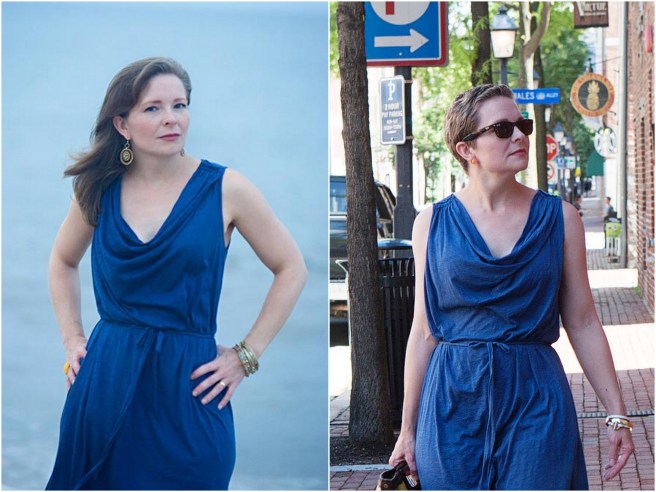
then and now blue dress

Sally took the picture on the left two years ago when our families vacationed together at the beach.  The picture on the right was taken this summer in Old Town. I really do love that dress! Emma Clare saw the older one recently and remarked that it hardly looked like me.  “I sure had a lot of hair there, didn’t I?” Her reply, “Well, yeah.  And you look a lot younger.” Thanks kid.  Anyway, I thought I’d use the two side by side to demonstrate how my taste in earrings has changed.  I stopped wearing the big hoop earrings as soon as I shaved my head– with a scarf tied around my head, I felt like a pirate.  No thank you.  I still held onto my other favorite big earrings, though, I think the fact that the scarf I usually wore had a long tail made it still feel like I had long hair. Now, though, my hair is decidedly short.  Every once in a while I try the big earrings again, and I just don’t feel like they’re right.  So now, I tend to favor chunky studs– Kate Spade makes several different pair that I love and are actually pretty reasonable. Plus, now that they’re so popular, there are a lot of knock offs around! I think I’ve got two or three pair of Kate Spade studs and a couple from covet, a favorite local boutique. I want them to be big enough to be seen, but not big enough to fall past my earlobes. I’ve got enough basics to keep me happy, but now I’m on the lookout for something new.

It’s Official.

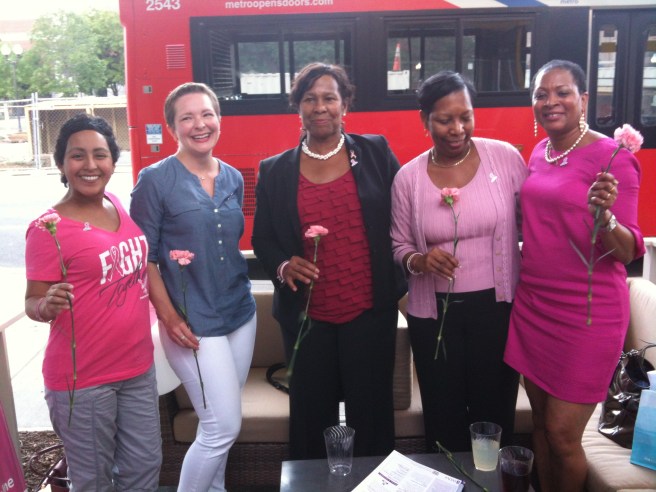
making strides group

I made some new friends last night.  My first survivor event.  They gave me a pin.  I had to wear it.  It said survivor. You know how I feel about that word.  Apparently the ice breaker at this kind of event is to ask how many years you’ve been a survivor.  So not only am I a bit uncomfortable about that moniker to begin with, but I have no idea how to answer that.  In my mind, I guess I mark survivor status from the date of my surgery, which puts me at almost five months.  One woman thought I should mark it from date of diagnosis, because I’ve been surviving since I heard the surgeon tell me that I had cancer. So that would be ten months. It must be easier when it’s something like five years. At any rate, I suppose it’s official, I’ve got the pin and everything.  I’m a survivor now, and I guess I’m going to have to get used to saying it.

Sleeping Like a Baby

sleep

That’s sort of the point I am at now.  And I guess I’m thankful for that, it’s better than just after I was diagnosed with cancer, when I would fall asleep fine from sheer exhaustion, but then wake around 1:30 am, unable to fall back asleep.  (I became rather familiar with the television schedule, I watched Closer reruns at 3am, and Vegas at 4.  I don’t ever remember that even being on in primetime…)  Now, I struggle to fall asleep, and feel like I’m waking up all the time.  Despite the four pillows that I’m now up to, I just can’t get comfortable.  It’s really all because of  the tissue expanders, and once those are out, I anticipate that I’ll sleep like a baby.  One of my babies, who slept through the night almost immediately, not one of those colicky, up-every-hour kind of babies.  If they’re the measure, then I guess I sleep like a baby now.

On Being Flexible | Part One

I'm not that flexible
I’m not *that* flexible

Having just been to the doctor’s office this week, surgery’s back on my mind.  Immediately after the mastectomy, of course some pain and weakness are totally expected. Since I’d spent time with the physical therapist before the surgery, I knew that my range of motion would be limited at first.  I could raise my arms to shoulder level as soon as possible, and by the end of six weeks I should be able to raise my arms straight up over my head.  She cautioned me that I should take things slowly, but that I needed to work to get back a full range of motion.  Being overprotective would actually work against me, she said she’d worked with women who couldn’t raise their arms higher than their shoulders years after their mastectomy.  Determined not to have that problem, I worked on her exercises to have a full range of motion as soon as it was allowed.  At this point, I think my shoulders are as flexible as they ever were.  The pectoral muscles are still an issue.  They’re always a little tight, when the physician’s assistant described it as my body’s “white noise,” I think she got it just right.  There’s always a tightness, but I don’t always notice it.  Then there are times when those muscles are definitely spasm-ing (is that a word?) and while it’s not painful, it’s really uncomfortable.  Those muscle issues should lessen after my final surgery, though they could continue long after I’m “back to normal.”  In chatting with my doctor, I asked if exercise would lessen or exacerbate the muscle tightness.  He assured me that stretching is good, but strength building of those muscles might cause more harm than good.  So no push ups for me!  Can’t say I’m too sad about that!  (Though I do miss the plank and push up heavy neighborhood boot camp…)  Still, I can work on my arm muscles, and he encouraged me to strengthen my back.  Apparently, the way the muscles are pulled causes the shoulders to want to slump forward, so strengthening my back will help naturally pull my shoulders back into place.  Right now, I think I’m focusing on getting my groove back on the trails, but after I get the post-surgery green light, I’ll be adding some weights into my running routine to keep my arms and back strong.

Re-Pre-Op

chemo-103
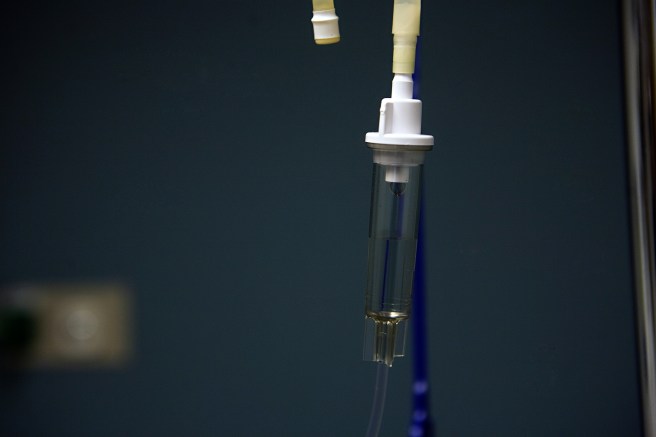
Hopefully just one last IV for me for a very long time

I was back at the plastic surgeon’s office today, for my second pre-op appointment.  My surgery isn’t scheduled until after school starts, but he likes to do the pre-op appointments early to be sure I’ve had time to ask any questions and get everything I need.  I came away with two more scripts– heavy duty antibiotics to prevent infection after the surgery and more lovely percocet (which I probably won’t need).  He explained to me that this surgery is much less invasive and all the trauma has already been done, so it should be a pretty easy recovery.  The mastectomy involved cutting, moving, and stretching of muscle, and that hurts.  But this surgery will literally be a swap out, so no new cutting or stretching.  I also got a pamphlet for medical grade compression gear, we’re talking gear so tight it requires multiple sets of hooks and eyes just so you can zip it up.  So if your spanx just aren’t cutting it and you want something even stronger, I can totally hook you up.

The Power of Lipstick

This weekend an article on the transforming power of lipstick popped up on twitter, and of course, I had to read it immediately! The author was in a rush out the door, but stopped to quickly apply some lipstick and was amazed at how much better she felt about how she looked.  She polled some of her blogger friends, including my friend Maria Jose, the Very Busy Mama, on their favorite transforming lipstick. It’s been pretty important to how I feel about how I look, so I wanted to add my own homage to the transforming power of lipstick.

As I read, I had a hard time thinking of a single favorite lipstick.  I re-read the post, and the word transforming sort of jumped off the page, and then I knew.  Of course, my mainstay through chemo, the lipstick that went on after I tied a scarf around my bald head to announce to the world that I was the healthiest cancer patient they’d ever seen: Dubonnet by MAC.  Now that’s a transforming lipstick.

jamiemay2013-190

Photography by Sally Brewer Photography

Lipstick: Dubbonet by MAC

Beware the internet

jamieround1-103
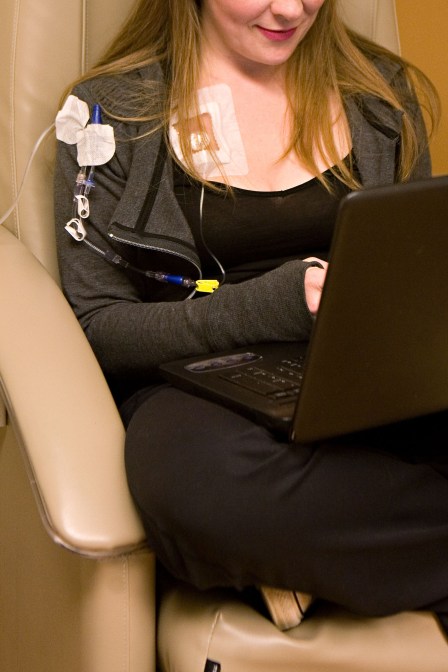
Googling (wigs, not medical info!) while at my first chemo treatment

I know it seems strange, me being here on the internet and all, telling you to stay off the internet.  The internet is a wonderful place– I can quickly find information, do some shopping, converse with old friends.  But there is a danger, too.  Anyone can put anything they want on the internet.  So when it comes to important things, health information, say, I’d steer clear of the internet.  Granted, there will be times when you have a question and can’t ask the doctor, or don’t want to trouble her, or you think it’s not important. First of all, bother your doctor!  Making sure you are healthy, that you understand what you need to do, what you need to look for– that’s her job.  But if you’re tempted to look online before the office opens, there are a few thing you should consider.

  • Consider the source: If I’m Googling for something medical, I’m not even clicking on the link if the address isn’t from a reputable source.  I’m talking something like Mayo Clinic, MD Anderson, or NIH. Since I have a science background, I’ll sometimes read an article from a scientific publication, but those can be a little heavy for people who aren’t accustomed to reading such literature.  Plus, any treatments they are studying are likely to be years away from use in the clinical setting, so they’re not all that applicable to someone looking for timely information.
  • Consider the publication date: Even if it looks like a super reputable source, if it’s five years old, the information isn’t really going to be helpful.  Treatments have changed so much in the past few years, and so have the support meds.  Times change, treatments change, experiences change.
  • Stay off the chat groups and blogs: Yep, I’ll say it again.  When you’ve heard one person’s story, you’ve heard one person’s story. So many people who are compelled to share their stories online have had a bad experience. They seem angry, they seem bitter. I’m not going to tell someone how to feel, but I don’t think that feeling angry makes the situation any better, and if you’re trying to keep a positive attitude, you don’t want to hang out with bitter people.  Garbage in, garbage out.

Just this week I was thinking about something that I’d “looked up” right away after hearing about it, but realized that it was in the pre-internet days, and I wondered how I did it.  It’s hard to imagine needing to find information and not being able to find it almost immediately with a few taps of your fingers.  But when it comes to really important health information, think before you Google.  Check the source, the date, and the attitude. If any of the three seem hinky, move on.  There are plenty of other places to get your information.  Like your doctor.